
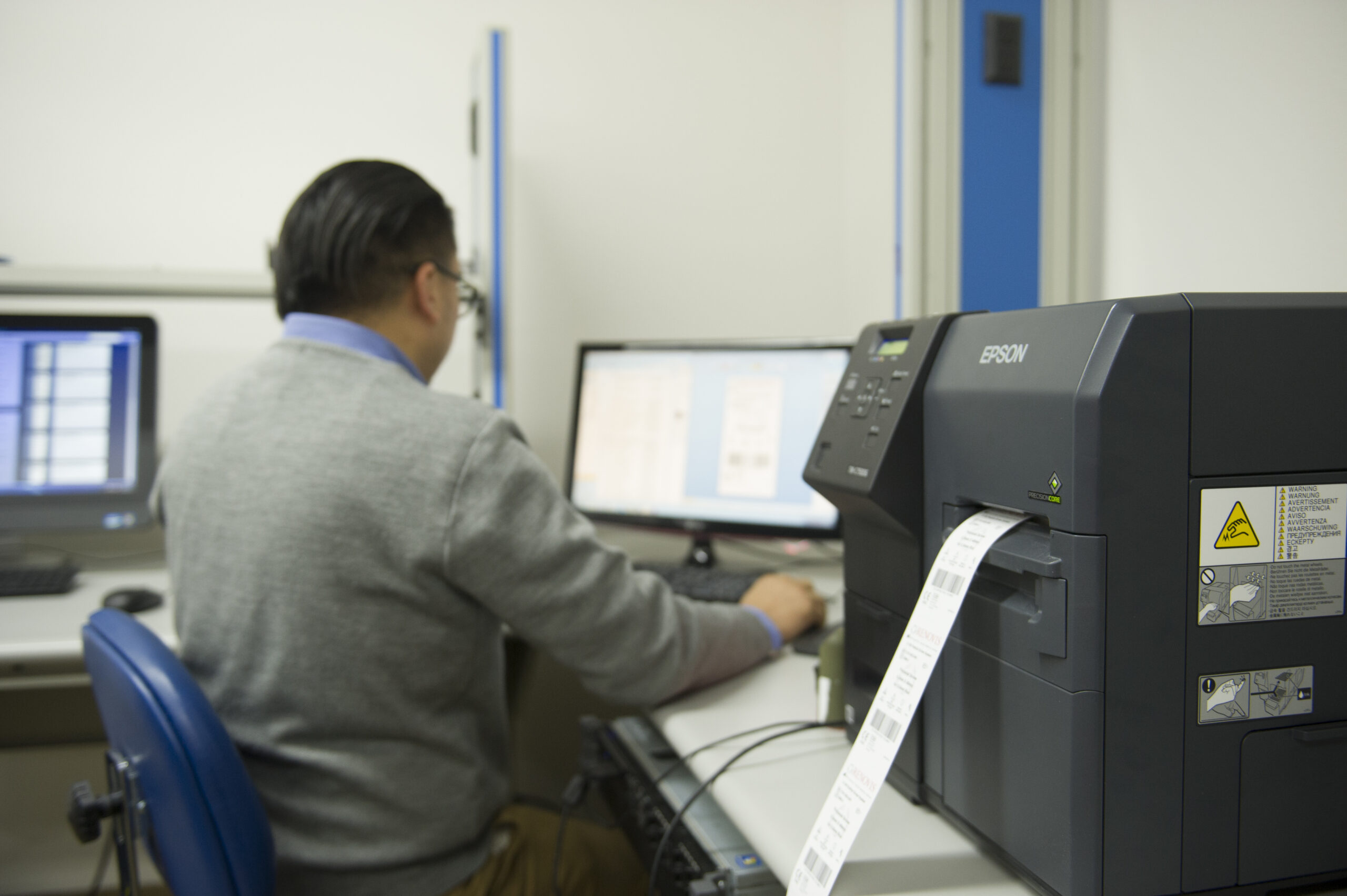
For half a century, the barcode on a medical device carton did one job. It answered a single question — which product is this? — and it gave the same answer at every stop between the packaging line and the sterile field.
That answer is no longer enough. Hospitals want to know which lot arrived, when it was made, how it was sterilized, and when it expires. Regulators want the identity printed on the label to match the record sitting in a national database, without anyone retyping a digit. Meanwhile, the symbol carrying all of that has to fit on a peel pouch the size of a postcard.
This article looks at three shifts happening at once: the maturing of medical device labeling UDI requirements, the migration to 2D barcode packaging, and the serialization trends moving from pilot programs into everyday production. Our earlier piece on best practices for labeling in medical device packaging covered materials, durability and user-focused content. This one goes underneath that, into the data carrier and the identity behind it.
The Label Became a Key, Not a Document
A Unique Device Identifier has two halves, and understanding the split explains most of what follows.
The UDI-DI is the device identifier. It identifies a specific version or model of a device and serves as the primary key for the device record in the applicable UDI database. Under GS1 Standards, that identifier is typically a Global Trade Item Number. Two other issuing agencies, HIBCC and ICCBBA, maintain their own formats for organizations that use them.
The UDI-PI is the production identifier. Depending on what appears on the device label, it may include a lot or batch number, serial number, manufacturing date, or expiry date. This half is what makes a single unit distinguishable from the thousands packed alongside it.
Both halves have to appear on the label in human-readable text and in machine-readable form. That much has been settled for years. What has changed is where the identity lives once it leaves your building. In the United States, UDI-DI records sit in the FDA’s Global Unique Device Identification Database. In Europe, the first four EUDAMED modules moved from voluntary to mandatory on 28 May 2026, covering actor registration, UDI and device registration, notified bodies and certificates, and market surveillance. The transition also creates registration deadlines for devices already placed on the EU market, so manufacturers should review the applicable EUDAMED timelines for their portfolios.
The practical consequence is subtle. Your printed label is now a rendering of a master record held somewhere else, and the two have to agree. Data registered in EUDAMED must reconcile with labeling and instructions for use, and inconsistencies can delay certification or trigger authority follow-up. Product identification stopped being a printing task and became a data governance task. Nobody sent out an announcement about that. It simply happened.
Why Linear Codes Ran Out of Room
UPC barcodes and their EAN cousins have carried global commerce since 1974, and they do one thing well. They encode a number. Nothing else fits.
Once a label needed a lot number and an expiry date in scannable form, manufacturers added a second symbol, usually a GS1-128. Two codes, two quiet zones, two placements to validate, and a label panel that was already crowded. On a small orthopedic implant pouch, something has to give. Usually it’s the symbol itself, shrunk to the smallest X-dimension the spec allows and printed on a surface that flexes every time someone picks it up.
Data matrices solve the density problem. A GS1 DataMatrix holds the GTIN, lot, serial number, and expiry date inside a symbol a few millimeters across, and it stays readable when part of the symbol is damaged. One scan at the point of use writes the exact lot into a patient record. When a field action follows, the affected units can be named rather than estimated.
Which Symbology Belongs Where
| Symbology | Typical use | Notes |
| GS1 DataMatrix | Device labels, small pouches, direct part marking | Dense, damage-tolerant, the default carrier for UDI |
| QR code with GS1 Digital Link | Consumer-facing and dual-purpose labels | Readable by any phone camera, resolves to online content |
| GS1-128 | Shipping cartons, cases, pallets | Long-established for logistics units |
| Aztec Codes | Ticketing, some clinical documentation | No quiet zone needed, rarely used for UDI |
GS1 Digital Link is also worth watching, although its current role differs between retail and healthcare. In retail, a QR Code carrying a GS1 Digital Link URI can connect product identification with online information. Healthcare product identification follows a different model. GS1 specifies GS1 DataMatrix as the 2D carrier for healthcare identification and traceability, while software can translate the encoded GS1 identifiers into a Digital Link URI when access to online resources is needed.
Serialization Trends: From Batch Identity to Unit Identity
Lot-level control answers the question “which run was this from.” Serialization answers “which unit is this,” and the difference matters more every year.
Pharmaceuticals got there first, by law. Under the US Drug Supply Chain Security Act, every salable unit carries a GS1 DataMatrix encoding the product code, serial number, lot, and expiry, with enforcement phased across manufacturers, wholesalers, and dispensers. Europe reached a similar place through the Falsified Medicines Directive.
Medical devices have no blanket serialization mandate in the US. Adoption is happening anyway, driven by four pressures that have little to do with each other.
- Implantables. EU MDR implant cards and hospital registries both want unit-level identity. A lot number does not tell a surgeon which specific device went into which patient.
- High-value capital equipment. Warranty, service history, and field modification records all attach cleanly to a serial number and messily to anything else.
- Diversion and counterfeiting. Product authenticity checks depend on an identifier that cannot be guessed or reused. Serialized codes plus a verification lookup make gray-market resale considerably harder.
- Hospital purchasing. Health systems running scan-based inventory management increasingly ask suppliers for unit-level data, because it removes a manual step from their receiving dock.
Aggregation follows serialization almost automatically. Each unit belongs to a pouch, each pouch to a shelf carton, each carton to a case, and the case to a pallet with its own SSCC (Serial Shipping Container Code). Building that parent-child hierarchy at pack-out means a distributor can scan one case label and know exactly what is inside, without opening anything. Supply chain traceability stops depending on paperwork and starts depending on captured events.
The result is a digital supply chain in which product traceability is queryable rather than reconstructable. Recalls narrow from a full lot to a shipment. Consignment reconciliation takes hours instead of days. Expired stock gets flagged before it reaches a shelf rather than after.
What This Actually Changes on the Packaging Line
Data strategy is pleasant to discuss in a conference room. The line is where it either works or does not.
- Code generation: Codes should be generated from validated data at print time, never pasted in as image files from an earlier job. That single rule prevents a large share of the labeling errors that end in a field correction. Encoding rules, application identifiers, and URI syntax all need to come from the labeling system, not from a designer’s asset folder.
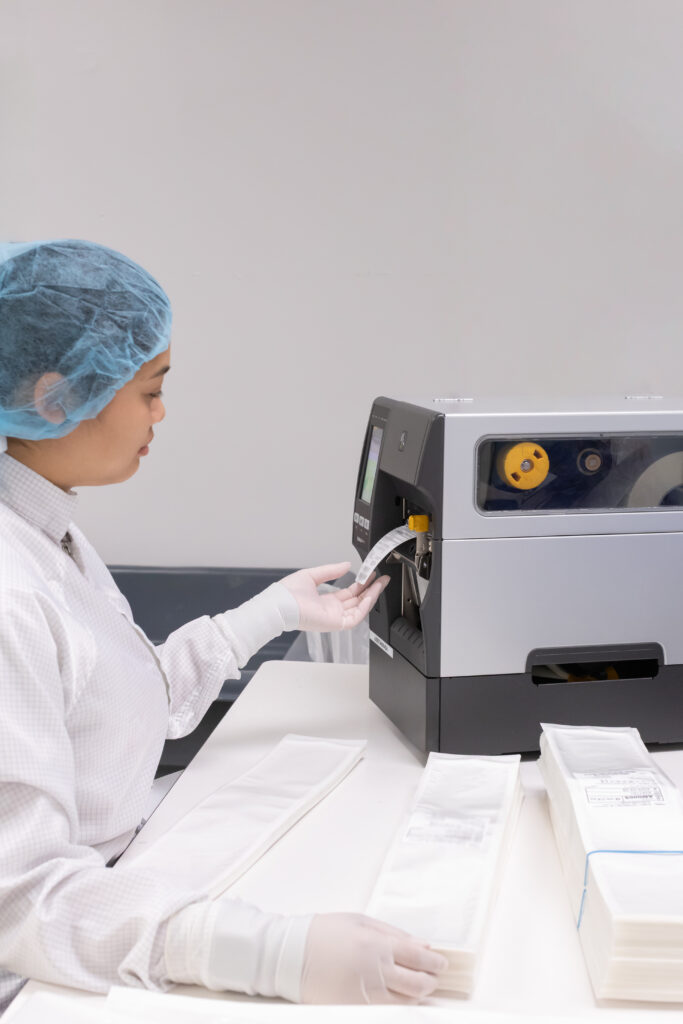
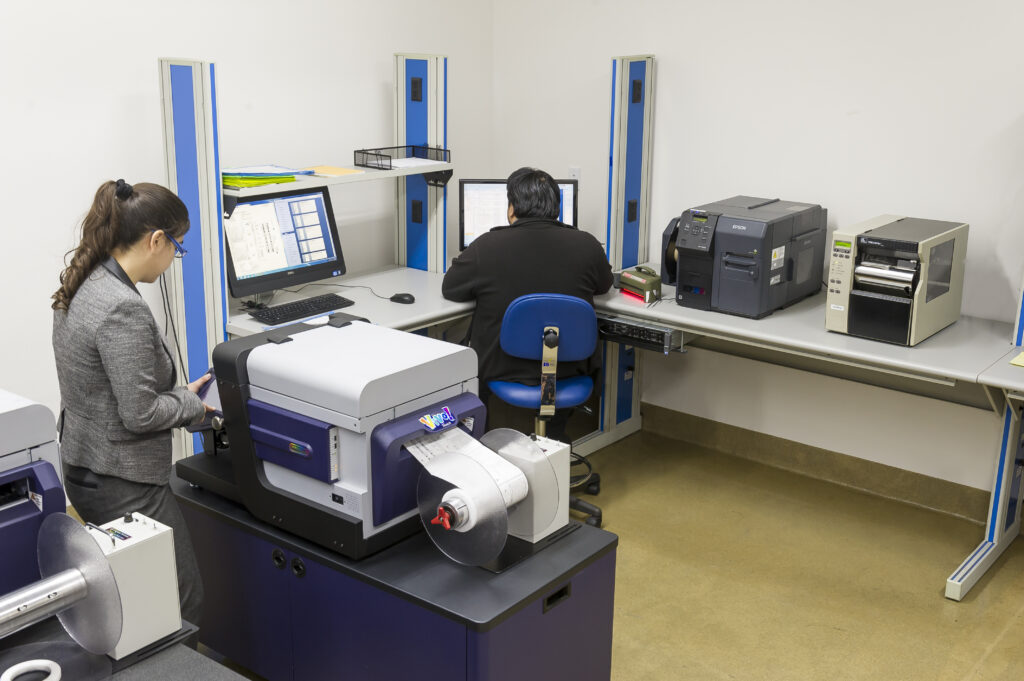
- Printing systems: Static artwork still runs well through flexographic printing on pre-printed label stock, which remains the economical choice at volume. Variable content — lot, serial, dates — goes on through thermal transfer, inkjet or laser marking. Digital printing has taken over short runs and multi-language versions, where plate costs used to make small batches painful. Many programs end up combining pre-printed stock with inline variable marking, which keeps color quality high and still allows unit-level data.
- Verification systems: Printing a 2D code is easy. Printing one that grades well after everything else happens to it is not. Barcode creation software and printers involved in the 2D transition need to follow the relevant ISO/IEC quality standards, and ISO/IEC 15415 grading is the accepted measure for 2D symbols. Inline cameras positioned over conveyor belts can grade every symbol at speed, while a handheld barcode scanner at pack-out gives operators a second confirmation. Define an acceptable verification grade during validation and monitor production against that requirement. A downward trend can reveal process drift before codes become unreadable.
- Sterilization effects: This is the part that surprises teams coming from other packaging industry segments. Ethylene oxide, gamma, and e-beam processing can shift ink color, yellow a substrate, and reduce the contrast a scanner depends on. A symbol that grades well before sterilization may perform differently afterward if the process changes the substrate, ink, or contrast. Verification belongs on the post-sterilization side of the process, and ideally on aged samples too. Sterilization services and label validation are the same conversation, even when they sit in different departments.
- Scanning equipment: Laser scanners sweep a single line of light and physically cannot read a 2D symbol. Camera-based imagers read both, and most scanner guns sold in recent years are 2D-capable. Audit your own plant hardware before assuming the problem lives downstream.
Artwork and Data Have to Be Right Before Anything Prints
Every labeling failure has a paper trail, and it usually starts upstream of the press.
Modern label design software handles GS1 syntax, Digital Link URI construction, and multi-language layouts natively. The value comes from connecting it to the systems that hold the truth — ERP for product details, PLM for specifications, and the regulatory database records that must match what gets printed. Artwork management systems then govern versions, approvals, and change history so that a revised expiry format does not quietly reach one site and skip another.
A few habits separate teams that sail through audits from teams that do not:
- Keep one master source for product information, and let every label pull from it.
- Version packaging artwork and the data mapping together, so an approval covers both.
- Validate URI syntax and check digit logic before a proof goes out, not after a print run.
- Reconcile label content against GUDID and EUDAMED records on a set schedule rather than in response to a finding.
Regulatory compliance in labeling has become an exercise in data hygiene. The printing part is comparatively well understood.
When the Label Points to a Web Page
A GS1 Digital Link code resolves to a URL, which means part of your labeling now lives on a web server. Availability of that page becomes a labeling concern, and this catches organizations off guard.
Consider the failure mode. A clinician scans a QR code on a carton and reaches an error page. From their perspective, the label failed. Resolver uptime, response time, and content accuracy all belong in the same review cadence as artwork.
A connected code also introduces basic digital-governance considerations. The destination has to remain available, secure, and accurate. Malformed data or overly aggressive security services can prevent a legitimate scan from reaching its destination, while online attacks create a separate reason to protect connected systems. The site owner should work with whoever manages the security solution to test real scan traffic before launch.
One principle keeps this manageable. The printed label must remain self-sufficient for anything safety-related. Operating rooms lose signal, hospital networks segment aggressively, and a device may be used in a location with no connectivity at all. Online content extends the label. It does not replace what has to be readable on the pack.
Smart Packaging, RFID and the Digital Product Passport
The next layer is already visible in adjacent sectors.
RFID tags have found solid footing in surgical kits, cath lab inventory and consignment stock, where reading a full cabinet without line of sight saves real time. Two things hold wider adoption back. Tag cost still rules out low-value disposables. Metal instruments and fluid-filled containers reflect and absorb RF energy, so those applications need careful tag selection and placement before reads become reliable. For high-value items with tight inventory control, the arithmetic works today.
Smart packaging in the broader sense covers anything that records a changing physical condition, from temperature indicators to tamper-evident electronic seals. Connected packaging, by contrast, uses a passive code to link a physical unit to a live digital record. The second approach is cheaper and is where most of the near-term movement sits.
Sustainability regulation is pulling in the same direction. The EU’s Digital Product Passport under the Ecodesign for Sustainable Products Regulation requires a structured digital record reachable through a data carrier. Battery passports become mandatory on 18 February 2027, with iron and steel, textiles, tyres and other categories following through 2029. GS1 Digital Link and GTIN sit at the center of the identifier and resolution model connecting a product to its passport. Medical devices are not the immediate focus of these requirements, but Digital Product Passport programs are worth watching because they show how regulators and industries are approaching persistent digital product identity.
For device makers with over-the-counter or home-use lines, the commercial side is worth noting. A scannable code that surfaces sourcing information, sustainability efforts, and setup guidance supports consumer trust in a way a printed insert cannot match. Retailers see the same codes as a route to better traceability and inventory management, while brands use them for consumer engagement. Customer engagement and marketing opportunities are genuine side benefits, though in the healthcare industry they follow compliance rather than lead it.
A Workable Sequence
Programs that go badly usually go badly because everything was attempted at once. A staged approach holds up better.
- Inventory what you print. List every SKU, its current symbology, its issuing agency, and where its data lives. Portfolios almost always contain more variation than anyone expects.
- Fix the data layer first. Reconcile ERP, labeling system, and registry records. A 2D program built on inconsistent product details reproduces those inconsistencies at higher resolution.
- Pilot on one product family. Choose something with a stable label and a forgiving substrate. Print dual codes, verify after sterilization, and put samples through the distribution chain.
- Grade everything, then keep grading. Establish baseline verification data before scaling. Trend it, because print quality drifts slowly and no single job announces the decline.
- Test at the receiving end. Ask two or three customers to scan pilot units on their own scanning equipment. Their systems will find issues yours never will.
- Scale by artwork cycle. Fold code changes into planned revisions instead of forcing a portfolio-wide relabel. Portfolio-wide packaging transitions can take many months, particularly when artwork changes have to be coordinated across products, suppliers, and production sites.
Sequencing matters most where a contract partner is involved, since artwork, code generation, and line configuration all have to move together across sites.
Where PRO-TECH Design Fits
PRO-TECH Design & Manufacturing is an ISO 13485 certified contract manufacturing organization supporting device companies across contract packaging, assembly, labeling, and sterilization. That combination matters for this work specifically. The team applying your label is the team that knows what your sterilization cycle does to it.
Traceability starts earlier than most labeling projects assume. Our receiving and receiving inspection process captures identifiers as components and devices arrive, which ties incoming lots to the units we assemble, package and sterilize. That record follows the work order through production rather than being reconstructed afterward. From there our supply chain management and warehouse services hold the same identifiers through storage and distribution. When a customer asks which lot went where, the answer is a query rather than an investigation.
Whether you are adding a 2D symbol alongside an existing UPC, moving to unit-level serialization, or working out how a labeling change interacts with a validated sterilization process, we can help you sequence it without disrupting supply.
Contact us to talk through your labeling roadmap.
FAQs
What is Pro-Tech’s experience with labeling medical devices?
Pro-Tech produces over 20 million labels in-house annually for our medical device customers. Our dedicated labeling department is used to working with many different types of devices and labeling requirements, and we know how to produce labels that can withstand the required sterilization protocol.
What is the difference between a UDI-DI and a UDI-PI?
The UDI-DI is the device identifier, a fixed code that identifies a specific device model and version. Under GS1 Standards, it is usually a Global Trade Item Number (GTIN), and it is the value registered in databases like GUDID and EUDAMED. The UDI-PI is the production identifier, covering lot or batch number, serial number, manufacturing date, and expiry date. The DI tells you what the product is. The PI tells you which specific unit you are holding.
Should we use a Data Matrix or a QR code?
GS1 DataMatrix is the standard choice for device labels, particularly where space is tight or the symbol will be marked directly onto an instrument. It packs more data into less area and tolerates partial damage well. A QR code carrying a GS1 Digital Link makes sense when the same symbol needs to serve a phone camera as well as a scanner, for example on home-use or over-the-counter products. Some labels carry both. The decision comes down to who is scanning and how much room the panel allows.
Do medical devices legally require serialization?
Not as a general rule in the US. The US Drug Supply Chain Security Act applies to prescription pharmaceuticals rather than devices. Adoption within devices is being driven by implant traceability requirements, hospital inventory systems and anti-counterfeiting programs. Many manufacturers of implantables and capital equipment serialize voluntarily because the operational benefits arrive well ahead of any mandate.
How does a serial number improve recall response?
Lot-level identity means a recall covers everything produced in that run, including units that were never affected. Unit-level identity narrows the field considerably. When each serial number is linked to a shipment and each case to a customer through aggregation data, a manufacturer can identify precisely which units reached which locations. Fewer units come back, notification is faster, and the customer disruption is smaller.
Which printing method suits 2D codes best?
For static artwork at volume, flexographic printing on pre-printed label stock remains cost-effective. Variable content needs an inline method — thermal transfer, inkjet or laser. Digital printing handles short runs and language variants economically. Method matters less than verification. Whatever you print with, grade the symbols after sterilization, because that step affects contrast more than most teams anticipate.
How do we confirm our codes will scan at the hospital?
Use verification systems that grade against ISO/IEC standards rather than relying on a read-or-no-read check, since a barcode scanner can often read a symbol that is close to failing. Inline camera systems over conveyor belts grade at production speed. Beyond your own plant, send pilot units to a few customers and have them scan on their equipment. Real-world receiving docks surface problems that lab testing does not.
Will RFID tags replace barcodes?
Not broadly, and not soon. RFID tags earn their cost in specific settings — surgical kits, cath lab inventory, consignment stock — where reading many items at once without line of sight saves meaningful labor. For most packaged devices, a printed 2D code costs a fraction of a cent and does the job. The realistic outcome is layered, with codes on everything and tags on the items where the economics justify them.
We still print only a linear code. Where should we start?
Start with data rather than print. Confirm that your product information is consistent across your ERP, labeling system, and regulatory database records, because a 2D program built on inconsistent data simply carries those errors forward. From there, pick one product family, add a 2D symbol alongside the existing UPC, and verify the result after sterilization. Then expand through your normal artwork revision cycle. Given typical packaging lead times, beginning now leaves comfortable room before 2D expectations tighten further.