

Choosing between pouching, trays, and form-fill-seal is rarely a simple packaging exercise.
For a medical device OEM, the format affects sterility maintenance, device protection, production speed, validation work, sterilization compatibility, freight, and the user’s first contact with the product.
This buyer’s guide compares pouch vs tray vs form-fill-seal options for sterile devices. It also gives a practical sterile barrier comparison for teams evaluating contract packaging support. The goal is to help OEM teams ask better questions before they commit to tooling, custom packaging inventory, or validation needs depending on the sterile packaging choice.
Why the Sterile Barrier Choice Matters
A sterile barrier system protects a sterilized device from microbial contamination until the package is opened for use. ISO 11607 is the core reference for sterile barrier packaging and packaging system requirements for terminally sterilized medical devices. ISO 16775 adds guidance for evaluating packaging materials, sterile barrier systems, and related process validation activities.
Those standards matter because a package that looks clean and professional may still fail. Seal channels can create a path through the seal. Sharp device features can challenge puncture resistance. Distribution vibration can expose weak material selection. A sterilization process can change film, adhesive, coating, or lidstock behavior. A package can even pass initial inspection and later show a seal failure after accelerated aging.
The right package has to balance:
- Barrier function
- Device protection
- Opening performance
- Production volume
- Packaging validation
- Sterilization compatibility
- Cost and operational fit.
Each format can work well when matched to the device and process. Each format can create problems when selected too late.
Quick Comparison: Pouch vs Tray vs Form-Fill-Seal
| Method | Best fit | Strengths | Tradeoffs |
| Premade pouches | Smaller devices, early builds, many SKUs, flexible launch plans | Low tooling burden, pouch size flexibility, fast changeovers, compact shipping | Less structural protection, greater concern for puncture strength, and overfilling |
| Rigid tray packaging | Heavy, sharp, delicate, premium, or multi-component products | Strong presentation, better device restraint, useful for surgical kits and trays, or kits | Higher packaging material costs, tray tooling, and more storage space |
| Form-fill-seal packaging | Stable products with higher volume | Automation, repeatability, rollstock efficiency, better throughput | More equipment setup, deeper process control, and less forgiving when product design changes |
This table is just a starting point. The better decision comes from testing the actual device in the actual package, after sterilization, transit simulation, aging, and opening assessment.
Option 1: Pouching and Premade Pouches
Pouching is often the most flexible starting point.
Premade pouches can support clinical builds, pilot production, low-volume commercialization, and product families with many sizes. They are common in healthcare packaging because they are familiar to operators, quality teams, and clinicians.
Pouches and bags are also the largest reported product segment in recent market research. Grand View Research reported that pouches and bags led the medical device packaging market with a 35.9% revenue share in 2024. That does not make pouching the right answer for every device, but it shows why OEM teams often evaluate it first.
Pouches or bags may use paper, film, foil, coated nonwoven, or breathable barrier materials. Some devices fit standard sterilization bags. Other products need high-barrier pouches for moisture, oxygen, or light protection. Flexible packaging can be compact, economical, and fast to introduce when the device does not need a rigid cavity.
The key advantage is pouch size flexibility. OEMs can test several dimensions before locking in a final packout. That helps when instructions for use, labels, accessories, or protective inserts are still changing.
However, the main risk here is physical protection. A device with a sharp edge, high mass, rough surface, or protruding feature can rub, flex, or puncture the pouch. This is where barrier properties, puncture resistance, puncture strength, and seal integrity become more than lab terms. They determine whether the package can survive handling and distribution.
Option 2: Rigid Trays and Tray Sealing
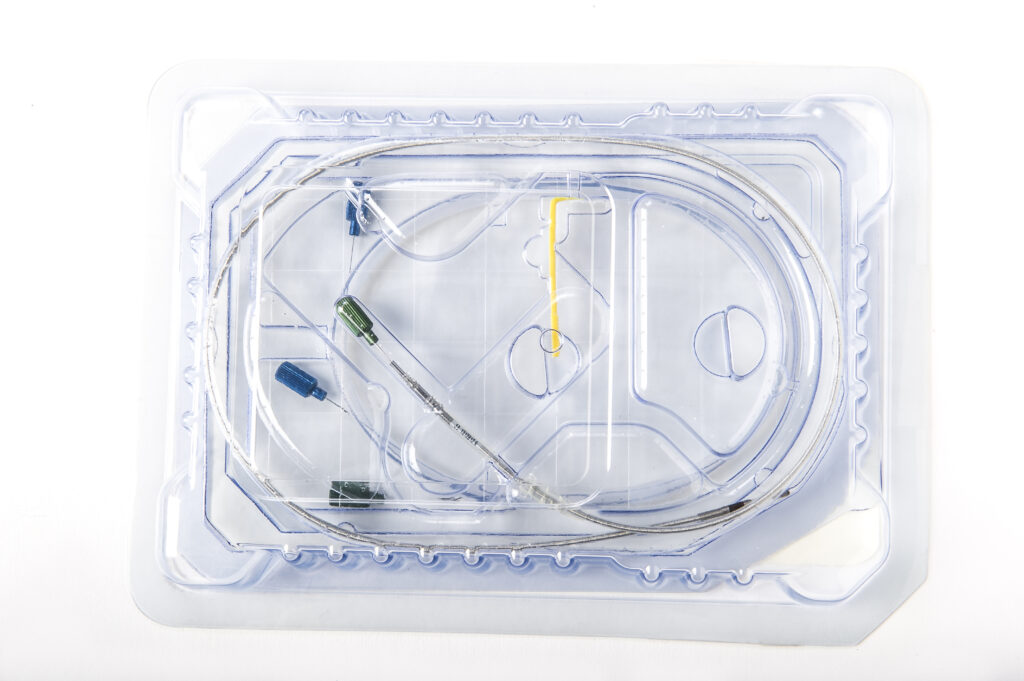
Rigid tray packaging gives the device a defined space. It can hold a product in position, separate components, protect delicate features, and improve aseptic presentation. This makes trays a strong fit for implants, instruments, procedure sets, surgical kits, and products that must arrive in a specific orientation.
Many trays are created through thermoformed packaging. In the thermoforming process, a plastic sheet is heated, formed over a mold, trimmed, inspected, loaded, and sealed with lidstock. The tray can include cavities, retention features, finger access points, label zones, and peel tabs.
Tray sealing requires tight control. A medical tray sealer must apply the right heat, pressure, dwell time, and tooling alignment. The finished seal needs enough seal strength to protect sterility, with peel strength that allows clean opening at the point of use. Too little strength can lead to seal failures. Too much can cause tearing, fiber tear, or difficult opening.
Tray overwrapping may be added for dust protection, grouping, tamper evidence, or handling. Device shipping trays can also be used inside a larger packaging system when the device needs restraint, but the sterile barrier is provided by another layer.
The tradeoff is cost and complexity. Trays usually require tooling, more storage room, more material, and more design time than a pouch. Those costs may be worth it when the device needs protection, presentation, or component organization.
Option 3: Form-Fill-Seal and FFS Packaging
Form-fill-seal packaging uses rollstock and equipment to form the package, load the device, and seal the final pack. In medical device packaging, form-fill-seal systems can create flexible packs, semi-rigid cavities, or tray-like thermoformed packages depending on materials and line design.
FFS packaging is often attractive when product volume is high and demand is stable. It can reduce manual handling, improve repeatability, and increase output. A well-developed line can support consistent forming, filling, sealing, printing, inspection, and packout.
Horizontal form-fill-seal is often used for devices that need flat placement or controlled orientation during loading. Vertical form-fill-seal may fit selected products that can be fed from above without damage, snagging, or misalignment. Some systems can support vacuum skin packaging or other formats where close product contact and controlled presentation are useful.
The limitation is flexibility. Form-fill-seal works best when the device design, accessory set, label position, and loading sequence are stable. A small design change can affect cavity depth, seal area, web tension, inspection, or loading speed. For early products still changing shape or configuration, premade pouches or a tray program may be easier to manage.
Sterile Barrier Comparison Factors OEMs Should Test
A useful sterile barrier comparison should be treated as a performance review of the finished package, not a simple preference for one format over another. The package has to prove that the microbial barrier remains intact after sealing, sterilization, distribution, storage, and opening.
The test plan should cover four pressure points:
- Barrier performance: Confirm that the selected packaging materials provide the right barrier properties for the device, sterilization process, shelf-life target, and storage conditions. A breathable lid, coated material, film, or foil can all support sterile barrier packaging, but each material behaves differently under sterilization and distribution stress.
- Seal performance: Evaluate seal integrity, seal strength, peel strength, and the risk of seal channels. Seal integrity tests may include visual inspection, dye methods where appropriate, bubble emission, vacuum decay, and other container closure integrity testing methods. ASTM F2096 is commonly associated with gross leak detection through internal pressurization, while ASTM D3078 is associated with bubble emission leak testing for flexible packaging with headspace gas.
- Physical protection: Study how the device sits inside the package. Sharp edges, heavy components, rough surfaces, or product movement can challenge puncture resistance and puncture strength. This is especially important when comparing premade pouches, rigid tray packaging, and form-fill-seal packaging.
- Aging and distribution: Challenge the package through accelerated aging, transit simulation, compression, vibration, and handling. These studies can reveal abrasion, corner damage, product movement, seal stress, and material changes that may not appear during initial inspection.
Any recurring seal failure should trigger a review of package design, material selection, sealing settings, loading practices, and device movement inside the pack. Seal failures are rarely solved by adjusting one parameter alone. The better approach is to look at the device, package, process, and test data together.
Sterilization and Material Selection
Sterilization methods can quickly narrow the packaging options. Ethylene oxide often needs breathable materials. Some radiation sterilization modalities can affect polymers, films, adhesives, inks, or coatings. Low-temperature sterilization methods may bring their own concerns related to material compatibility, residuals, moisture, or exposure conditions.
AAMI TIR 17 is useful when evaluating materials exposed to sterilization. In practice, OEMs should review the device, packaging materials, labels, adhesives, and protective components together rather than treating the package as an afterthought.
Primary packaging has to support the selected sterilization process and maintain the sterile barrier afterward. A high-barrier film may protect a moisture-sensitive product, but it may not be right for a process that needs sterilant penetration. A breathable lid may support sterilization, but may need added secondary packaging for dust or handling protection.
Material selection should also reflect clinical use. The package should open predictably, present the product clearly, and avoid fiber, tearing, curl, or device displacement during opening.
Cost, Scale, and Operational Fit
Packaging material costs are easy to compare, but the total cost includes much more. OEMs should factor in tooling, samples, sealer setup, cleanroom labor, inspection, scrap, sterilization load configuration, freight cube, shelf-life studies, complaint risk, and changeover time.
A pouch often has the lowest startup cost. A tray may reduce damage or improve kit organization enough to justify higher material and tooling expenses. Form-fill-seal can lower unit labor at scale, but the equipment and validation effort need a stable product and a reliable forecast.
The right choice should fit today’s launch plan and tomorrow’s volume. Many OEMs start with premade pouches, move to trays when protection or presentation demands it, and evaluate form-fill-seal when the product has matured. Others begin with rigid packaging because the device risk is clear from the start.
A Practical Decision Path for OEM Teams
OEM teams can make the comparison more useful by scoring each packaging method against the same set of questions. This keeps the discussion focused on device risk, production reality, validation evidence, and user experience rather than personal preference.
| Decision Question | Why It Matters |
| Can the device puncture, abrade, or stress the package? | Light, smooth devices may fit well in pouches or bags. Sharp, heavy, delicate, or multi-component devices may need rigid tray packaging or device shipping trays for added restraint. |
| How stable is the product design? | Premade pouches give OEMs more flexibility when device size, labels, accessories, or instructions for use are still changing. Form-fill-seal systems usually work best once the design and loading sequence are stable. |
| What does the user need at opening? | A package should open without sudden force, product drop, lid tear, or loss of sterile presentation. Trays often support organized presentation for surgical kits, while flexible packaging may be better for simpler devices. |
| What volume and SKU mix will the production line handle? | Pouching can support mixed SKUs and lower-volume builds. Tray sealing may improve repeatability for products that need defined placement. FFS packaging can support higher throughput when demand is predictable. |
| What evidence will quality and regulatory teams need? | Each format must support packaging validation, seal integrity tests, aging, distribution testing, and sterilization compatibility. A faster packaging option is not useful if it creates repeated validation failures. |
Once those questions are answered, the likely direction becomes clearer. Pouching often fits launch builds, smaller devices, and programs that need pouch size flexibility. Rigid tray packaging moves ahead when protection, presentation, or component organization carries more weight. Form-fill-seal becomes more attractive when the product has matured, volume is stable, and the production line can justify automation.
The decision should also be revisited as the program grows. A package that works well for pilot production may not be the best choice for full commercial scale. In the same way, a highly automated format may be unnecessary before the product design and demand forecast are stable.
Conclusion: Choosing the Right Sterile Barrier System and How the Right Partner Can Support the Decision
The best sterile barrier system is not always the most complex or expensive option. It is the one that protects the device, supports the sterilization process, passes packaging validation, opens cleanly for the user, and scales with production demand.
Pouches can offer speed, flexibility, and lower startup costs. Trays can add structure, organization, and a stronger presentation for devices that need more protection. Form-fill-seal packaging can improve efficiency when the product design is stable, and volume supports automation.
The right choice depends on how the device, packaging materials, sterilization method, seal design, production line, and end-user needs work together.
At PRO-TECH Design, we help OEMs evaluate those factors before the package is locked.
As an ISO 13485-certified contract manufacturing organization, PRO-TECH Design supports contract packaging, assembly, sterilization coordination, and packaging validation planning for medical device programs. That early review can help reduce late changes, repeated test failures, avoidable costs, and production delays.
If your team is comparing pouch vs tray vs form-fill-seal packaging, we’re here to help turn the comparison into a practical path from package concept to validated production. Contact us today to discuss your device, production goals, and sterile packaging requirements.
FAQs
- What is the main difference in pouch vs tray vs form-fill-seal packaging?
Pouches use premade flexible materials that are loaded and sealed. Trays use a rigid or semi-rigid cavity with a lidstock. Form-fill-seal packaging uses rollstock and equipment to form, fill, and seal the package in one connected process. The right choice depends on device geometry, sterile barrier requirements, volume, and validation risk.
- Which format gives the strongest sterile barrier?
No format is automatically strongest. A sterile barrier system depends on material selection, microbial barrier performance, seal integrity, sterilization compatibility, distribution performance, and aging results. A well-designed pouch can outperform a poorly designed tray, and a validated tray can outperform an FFS package with weak process controls.
- When should an OEM choose premade pouches?
Premade pouches are a good fit for smaller devices, early-stage builds, lower-volume products, and programs with frequent SKU changes. They offer pouch size flexibility and may lower startup costs. They are less ideal when the device is sharp, heavy, or likely to shift inside the pack.
- When is rigid tray packaging a better choice?
Rigid tray packaging is often better for heavy, delicate, sharp, or multi-component devices. It can improve product protection, organization, and aseptic presentation. Trays are also useful for surgical kits, procedure sets, and products that need a consistent orientation during opening.
- When does Form-Fill-Seal (FFS) packaging make sense?
FFS packaging makes sense when product demand is stable, volume is high, and the device can be loaded repeatedly. Horizontal form-fill-seal is often used when the device needs flat placement. Vertical form-fill-seal may fit selected products that can be fed from above without damage or misalignment.
- What causes seal failure in sterile medical device packaging?
Common causes include contamination in the seal area, wrinkles, wrong sealing parameters, poor material pairing, tray flange distortion, overfilled pouches, product contact with the seal, and device movement during distribution. Seal channels are a common warning sign because they can compromise the sterile barrier.
- Which seal integrity tests are used for pouches and trays?
Common seal integrity tests include visual inspection, dye methods where suitable, bubble emission, vacuum decay, and other container closure integrity testing methods. ASTM F2096 and ASTM D3078 are commonly referenced in packaging leak testing. Seal strength and peel strength testing are also used to evaluate package performance.
- How do sterilization methods affect packaging choice?
Sterilization methods affect material compatibility, breathable barrier needs, adhesive performance, film strength, and package aging. Radiation sterilization modalities may affect some polymers. Low-temperature sterilization methods may require special attention to porosity, residuals, humidity, and material behavior.
- How should OEMs compare packaging material costs?
OEMs should compare total cost, not just the price of the pouch, tray, lid, or rollstock. Total cost includes labor, tooling, inspection, scrap, sterilization load configuration, freight cube, validation, shelf-life testing, and complaint risk.
- Can pouches, trays, and form-fill-seal formats be combined?
Yes. A device may sit in device shipping trays and then be placed in pouches or bags. A tray may be sealed, placed in a carton, or covered with tray overwrapping. A form-fill-seal package may use flexible packaging or thermoformed packaging, depending on the materials and equipment.